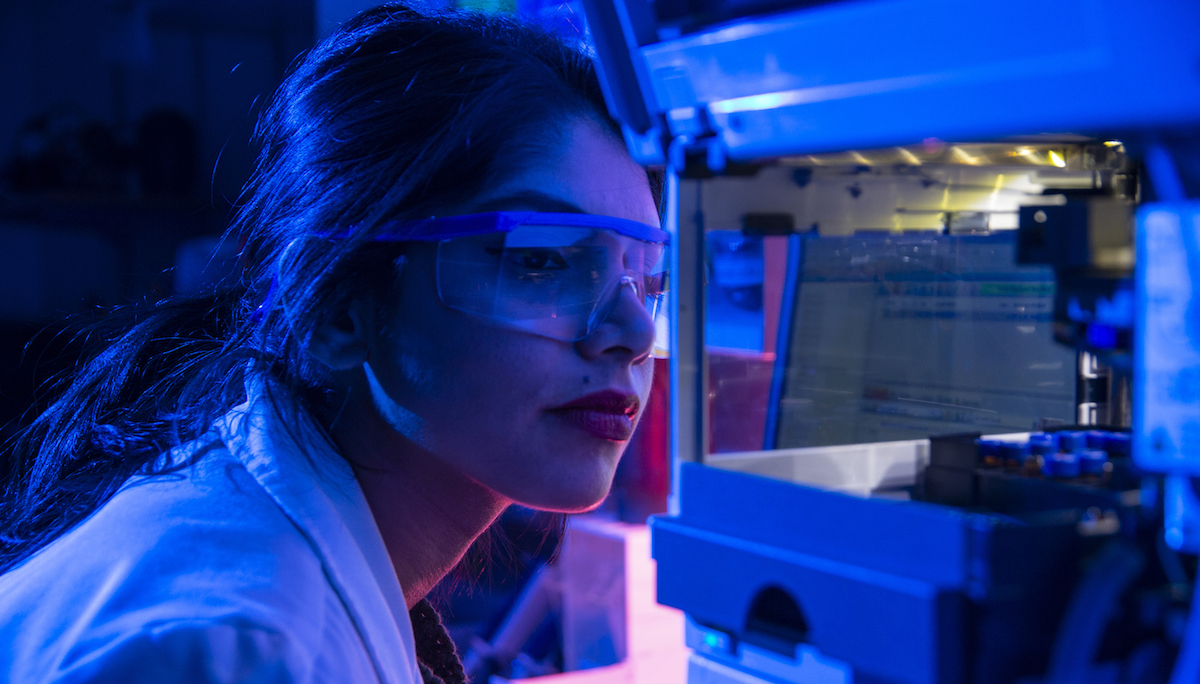
At Florida Atlantic University, our R1-designated Department of Chemistry and Biochemistry offers a dynamic, research-intensive Ph.D. program where graduate students work at the forefront of scientific discovery. Our faculty-led research spans the molecular to the macroscopic, integrating chemistry, biology, computation, and materials science to address some of the most pressing challenges in human health, sustainability, and technology.
Graduate students at FAU are not just trainees - they are collaborators, innovators, and future leaders in academia, industry, and government research.
CLICK HERE TO CONNECT WITH US AND LEARN MORE
Our Ph.D. program allows students to tailor their research experience across a broad range of cutting-edge disciplines.

|
Drug Discovery & Medicinal ChemistryFAU’s drug discovery research operates at the interface of chemistry and biology, combining medicinal chemistry, chemical biology, and translational science. Faculty employ small-molecule and peptide synthesis (solution and solid-phase), combinatorial library design, marine natural products isolation, ligand- and target-based computational modeling, and in vitro biochemical and cell-based assays. This highly flexible research ecosystem has produced novel anticancer, antimicrobial, CNS-active, and imaging agents. Graduate students gain hands-on experience with industry-relevant drug discovery pipelines, preparing them for careers in pharmaceutical and biotechnology sectors. |

|
Chemical BiologyChemical biology at Florida Atlantic University bridges synthetic chemistry, biochemistry, and molecular biology to interrogate complex biological systems with molecular precision. Faculty research integrates chemical design with biological interrogation to reveal structure–function relationships that underlie health and disease. Key research areas include:
Graduate students in chemical biology develop a deep understanding of the relationship between molecular structure and biological function, while gaining hands-on experience in probe design, fluorescence spectroscopy, biochemical assays, and cell-based imaging. This training provides an outstanding foundation for careers in biomedical research, biotechnology, pharmaceutical sciences, and academia. |

|
Synthetic Organic ChemistryOur synthetic organic chemistry program emphasizes reaction discovery, mechanistic insight, and asymmetric catalysis. Faculty focus on:
These studies enable the development of therapeutically relevant molecules, including neuroprotective agents, novel antibiotics, and carbohydrate-based cancer therapeutics. |

|
Biophysical & Computational ChemistryBiophysical and computational chemistry research applies physical principles to biological systems at atomic and molecular resolution. Using spectroscopic, calorimetric, and computational techniques, faculty study:
Graduate students have access to FAU’s High-Performance Computing (HPC) cluster, featuring CPU and GPU nodes for advanced molecular simulations and data-driven discovery. |

|
Environmental & Analytical ChemistryAnalytical chemistry research at FAU leverages modern instrumentation to address complex chemical and environmental challenges through an integrated sensing framework that combines diverse platforms and advanced technologies. Core analytical techniques include:
Environmental chemistry research applies these tools to study water quality, nutrient cycling, and harmful algal blooms, with direct relevance to environmental health and sustainability. |

|
Materials ScienceMaterials science research focuses on the chemical design and synthesis of advanced solid materials with enhanced properties. Current efforts emphasize:
Techniques include confocal Raman microscopy, electron microscopy, and X-ray-based characterization methods. |
Chemistry Education ResearchFAU is a national leader in chemistry education innovation. Graduate students interested in education research gain rigorous training applicable to academic and leadership roles. |
A Ph.D. in Chemistry from FAU prepares you for leadership roles in academia, industry, government labs, and technology sectors — with competitive compensation and strong demand in research-intensive fields.
Ph.D. chemists and research scientists often earn well above the national average for scientific careers, with typical ranges extending into six figures depending on sector, specialization, and experience. For example, industry and senior R&D roles can exceed $120,000–$150,000+ annually in high-demand markets.
Employment for chemists and materials scientists is projected to grow by around 6% over the 2022–2032 decade, faster than average for all occupations, driven by demand in pharmaceuticals, biotechnology, environmental science, and advanced materials.
In-demand industries for chemistry Ph.D.s in 2025–2026 include pharmaceuticals, biotechnology, renewable energy, advanced materials, environmental technology, and chemical manufacturing.
Chemists and chemical scientists are employed across all U.S. regions, with roles ranging from research and development to regulatory science, quality control, process chemistry, and scientific leadership; graduate-level training (Ph.D.) significantly expands access to senior research and management positions.
Our graduates are distinguished contributors in:
Pharmaceuticals & biotech R&D
National laboratories and federal research agencies
Academia and teaching institutions
Environmental and sustainability science sectors
Florida Atlantic University’s Ph.D. program is a flexible, multidisciplinary doctoral degree designed to prepare students for leadership roles in research-intensive careers. Students engage in original, high-impact research while developing advanced problem-solving, communication, and independent thinking skills.
In addition to the University's general graduate admission requirements, the typical prerequisite to graduate studies in the Department of Chemistry and Biochemistry is the Bachelor of Science degree in chemistry or its equivalent. Students must have achieved a minimum 3.0 GPA in chemistry or chemistry focused degree, and scores of at least 150 (verbal) and 152 (quantitative) on the Graduate Record Exam.
The Chemistry Ph.D. Program is a multidisciplinary doctoral program in the Charles E. Schmidt College of Science at Florida Atlantic University. The Ph.D. program allows students to pursue a research program in most disciplines of chemistry. Our graduates go on to outstanding careers as researchers.
Students undergo rigorous training and have an opportunity to develop cross-disciplinary skills. Students take at least 80 credits of coursework which includes three core courses: Bionanalytical Methods (a two-part course), Synthesis and Characterization, Kinetics and Energetics (9 credits for the three courses), plus a nonthesis seminar (1 credit) and Introduction to Chemical Research (1 credit). The graduate electives (9 credits) may be selected from graduate-level courses offered in the Department of Chemistry and Biochemistry or other departments in the Charles E. Schmidt College of Science/Biomedical Science. The remaining credit hours (dissertation credits, minimum 25) are research-intensive. While the student's dissertation research may be highly focused in one of the sub-disciplines, the program curriculum provides a context for viewing this research in light of its relationship to other levels of organization and processes. The curriculum will be individually tailored to each student's research interests.
Chemistry Ph.D. Degree Policies and Procedures
This thesis program is designed for students whose career aspirations include securing industrial positions that demand technical mastery. Graduates of this program are exceptionally well-prepared for both high-impact roles in the industry and further academic pursuits in doctoral programs. Students take a minimum of 30 credits, which includes four core courses (9 credits): Bioanalytical Methods (2), Current Topics in Bioanalysis (1), Synthesis and Characterization (3), and Kinetics and Energetics (3). Additional requirements include a non-thesis seminar (1) and Introduction to Chemical Research (1). The graduate electives (9 credits) may be selected from graduate-level courses offered in the Department of Chemistry and Biochemistry or other departments in the Charles E. Schmidt College of Science/Biomedical Science. For the remaining credit hours, students conduct independent research under the supervision of a graduate faculty member, culminating in a thesis.
Chemistry M.S. Degree Policies and Procedures
This non-thesis program is designed for students whose career goals include industrial positions or further professional studies. Students completing this program are also well-positioned for further study in a doctoral program. Students take a minimum of 30 credits of coursework, which includes four core courses (9 credits): Bioanalytical Methods (2), Current Topics in Bioanalysis (1), Synthesis and Characterization (3), and Kinetics and Energetics (3). Additional requirements include a non-thesis seminar (1) and Introduction to Chemical Research (1). The graduate electives (19 credits) may be selected from graduate-level courses offered in the Department of Chemistry and Biochemistry or other departments in the Charles E. Schmidt College of Science/Biomedical Science.
The PREPChem program is crafted for college graduates with a bachelor's degree who aspire to elevate their knowledge and research skills for a thriving career in the chemical industry. This program offers a unique blend of traditional graduate classes in chemistry (9 credits) and cutting-edge courses in artificial intelligence (AI) (6 credits). AI is revolutionizing the field of chemistry by automating complex tasks, analyzing vast datasets, and accelerating drug discovery processes, making it an indispensable tool in modern chemical research and industry practices. All required graduate classes are provided through the Chemistry Department, while Data Science and AI courses are available through the College of Science or the College of Engineering and Computer Science. Upon completion of the 15-credit program, students will earn a postbaccalaureate certificate. Additionally, for those considering further academic pursuits at FAU, these credits can be seamlessly transferred toward an M.S. or Ph.D. program in Chemistry upon admission.
Earn your Ph.D. in Chemistry at Florida Atlantic University.
Join a collaborative research community dedicated to discovery, innovation, and societal impact.
Click below to express your interest
Connect with our advisors and faculty to learn more about research opportunities, funding, and career pathways uniquely available at FAU.
CLICK HERE TO CONNECT WITH US AND LEARN MORE
Feel free to contact us with any questions you may have: chemgrad@fau.edu



